
More on Tiradentes, Brasil
I got curious last night after writing the last post on the Brasilian town of Tiradentes, seemed like i should know why it was thus named, and it seemed like i would have asked at the time. Sometimes my memory is a little unreliable about stuff like that, so its lucky we have Wikipedia!
So, the town of Tiradentes is named after Joaquim José da Silva Xavier, also known as Tiradentes (tooth puller) due to his one time profession as an impromptu dentist. He was also a leading member of the Inconfidência Mineira, a revolutionary group formed in 1788 dedicated to the political independence of Brasil from Portuguese colonial rule.

Typical street in the town of Tiradentes in Minas Gereis, Brasil
The group, including Tiradentes was betrayed by one of their own members, and he was captured and eventually hanged in 1792 for treason, after a trial lasting nearly 3 years. Imagine 3 years in a Brasilian/Portuguese prison in the 18th Century, i think the eventual hanging would have been a relief.
The Human irony is that a man can be considered a villain by society one day, and for the very same reasons a hero the next. The place in Rio de Janeiro where Tiradentes was hanged (and quartered…) is named in his honour (Praça Tiradentes), there is a town in the inland state of Mina Gereis that bears his name, while his likeness is on the Brasilian 5 cent coin. He has been considered a revolutionary hero of the people of Brasil since the late 19th Century.
Another irony is that the town of Tiradentes, along with most of the state of Minas Gereis (which translates literally to General Mines), was built entirely by slaves (see previous post), and while the Inconfidência Mineira was agitating to lift the colonial yoke of Portuguese oppression from Brasil, they were still happy for the disenfranchised African slaves to be worked to death pulling the gold they so desired out of the ground. In fact the driving force for the proposed rebellion was to stop the gold that was being dug by the African slaves from the Brasilian soil being sent as tribute to the King of Portugal.
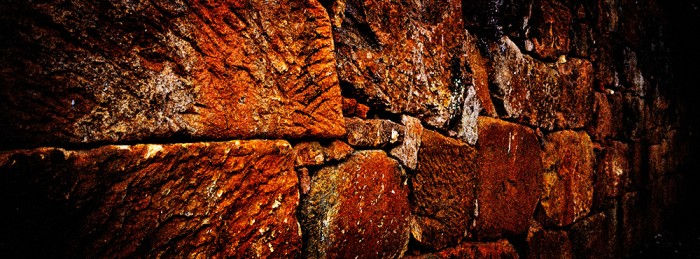
A 500 year old slave built wall still shows evidence of the hand tools used to carve it out of the solid stone
So really what it all came down to was greed, thus the coin is flipped again, was Tiradentes hero or villain?. Very little changes in the world it seems.
Both these images were taken on the Hasselblad XPan at dusk, and shot with Fuji Velvia 100.


